
Is my argument flawed?
Revisiting a Video I Published on May 16, 2025

Background Information and Overview
On May 16, 2025, I published a YouTube video titled “The Hypocrisy of Jordan Peterson.” The video is quite short, and I argue that Jordan Peterson, while regularly being highly unclear in his language, often demands overwhelming clarity from his interlocutors. I conclude that this is hypocritical, as Peterson regularly scolds people who communicate “ineffectively” in discourse, yet does so himself.

Since its publication, the video has received immense backlash. The like-to-dislike ratio is 22:90 (22 likes, 90 dislikes). I received dozens of comments disagreeing with my argument (many in very bad faith). However, after an initial spike of views, attention has flatlined.
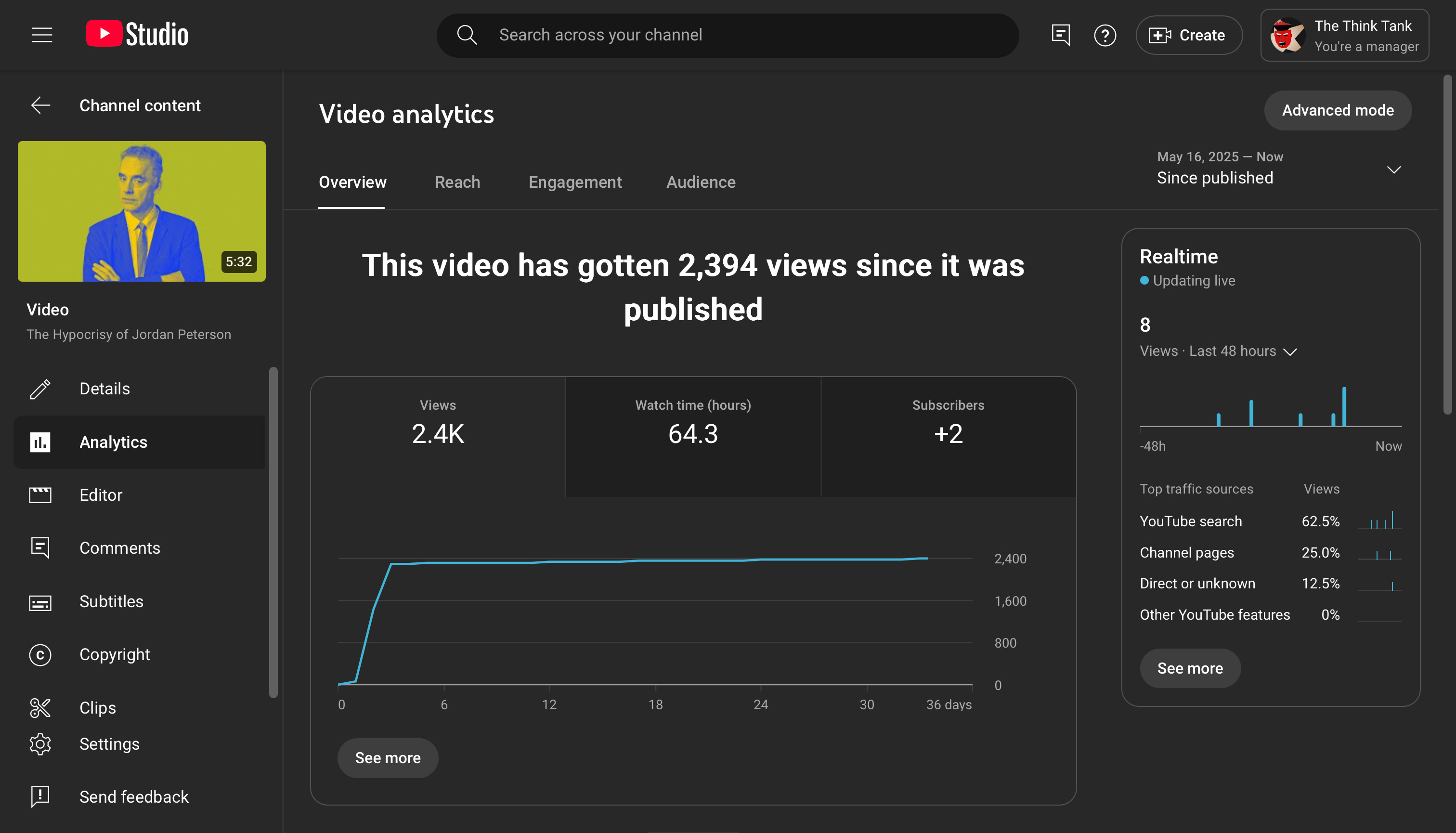
I must admit that I was surprised by the amount of negative feedback I received. Although I knew discussing anything related to Peterson was semi-polemical, I saw my critique as modest and largely inoffensive; obviously, it was not. I was doing the complete opposite of “preaching to the choir;” I was pleading to the mob.1 Despite my efforts to entertain my critics and address their rebuttals, I did not seem to change any minds.
This experience has taught me a valuable lesson: no half measures when presenting an argument publicly. When writing the video, I naively presumed the audience would already be somewhat in agreement with the video’s central premise and consider my argument a succinct illumination of Peterson's rhetorical hypocrisy (hence why the video is relatively short and uses few examples). I was not as rigorous in my argument as I should have been.
Following the backlash, I considered creating an additional video that addressed the concerns of the commenters while also providing more in-depth evidence to support my position. I decided to not do so for two main reasons: (1) I do not have many videos on my YouTube channel currently, and I do not want it to appear as though I am piggybacking on the popularity of Peterson for views, and (2) this video came out:
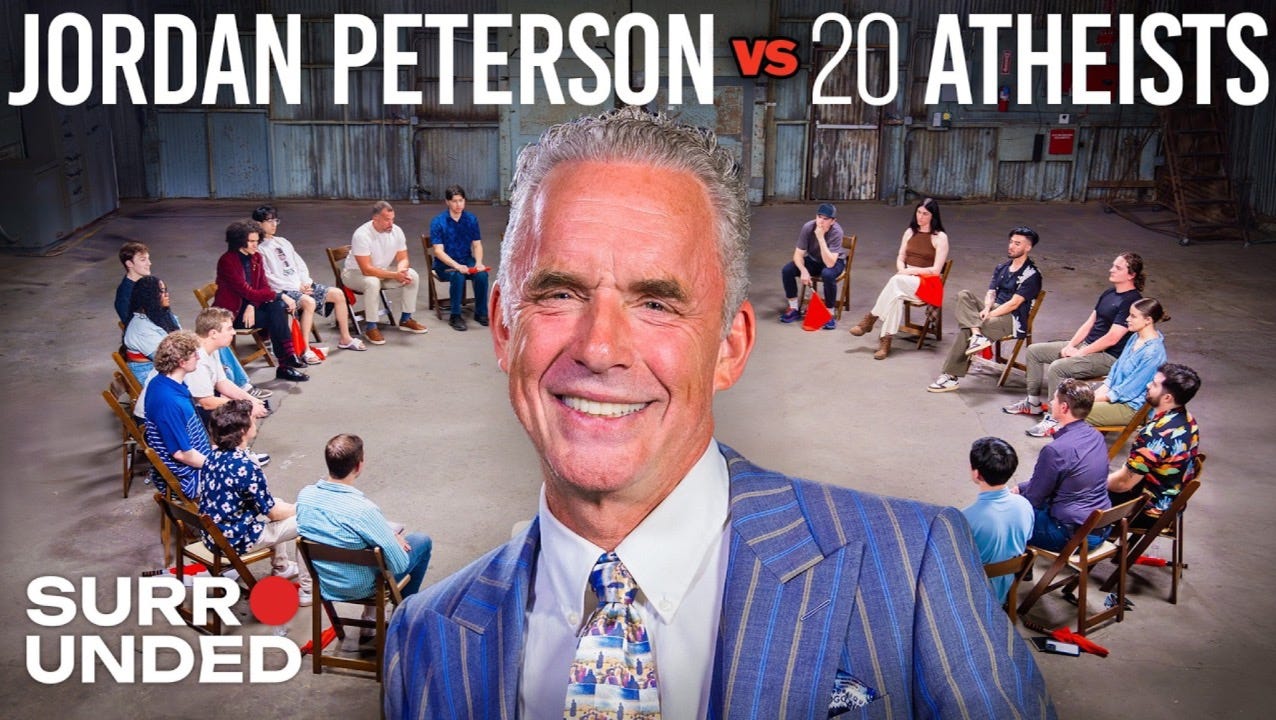
On May 25, 2025, Peterson appeared on Jubilee’s “Surrounded,” which is a terribly unproductive debate format where one individual is “surrounded” by roughly twenty disagreeers that I cannot help but watch. Discourse concerning Peterson's appearance was decisive: he performed poorly, largely due to his inability to provide focused and clear answers to his interlocutors.2 Numerous YouTubers responded to Jubilee’s video, including Alex O'Connor, Unsolicited advice, Rationality Rules, and others. Commenters were also very critical of Peterson’s approach to this “debate.”
While his appearance, in my view, further supported my original argument, due to the existing dogpile, I figured creating a new video would be low-hanging fruit, and I likely would have added little to the general discussion (beyond what I had already said). For those reasons, I chose not to pursue the topic on YouTube further. Yet, I still felt something needed to supplement my original video in case it gains more views in the future. Hence, I am writing this retrospect.
Here, I hope to do a couple of things. I would like to address some of the main criticisms I have received. Additionally, I want to add some concluding thoughts on the continued validity of my argument. Also, to clarify, I am not trying to create a “hit piece” on Jordan Peterson, nor do I harbour any hatred towards him; my intentions are not evil.
Entertaining My Critics
As I mentioned earlier, I received substantial backlash, much of which I responded to diligently in an attempt to strengthen my point and understand the opinions of others. This was not a very fruitful endeavour, but hopefully it shows my integrity in responding to negative feedback. In what follows, I revisit some of the criticisms that have been put forth.
“I lack understanding.”
A common rebuttal to my argument was that I simply am not smart enough to comprehend the complexities of Peterson’s opinions, ideas, language, etc. Since I apparently do not understand Peterson, my critique of his rhetoric is invalid, as the real problem lies in my ability to interpret information, not in Peterson’s ability to convey it. Thus, rather than demonstrating Peterson’s ineffective communication in discourse, I demonstrated my incompetence.
I accept the idea behind this criticism. If one does not understand something, how could their argument against it be valid or taken seriously? Yet, I do not concede that such a criticism applies to me or my broader argument. In the many times I have watched Peterson, I have seldom been legitimately perplexed by what is being said. That is, when Peterson speaks, I am not thinking “These sentences make no sense,” or that the idea being conveyed is utterly incoherent. Instead, I think, “How does this statement connect to Peterson’s thesis or opinion and the topic of discussion?”
For example, when Peterson appeared on Piers Morgan Uncensored, which I reference in my video, it is easy to understand what is being said. However, it is challenging to understand what is being conveyed in relation to the prompt. When questioned about his belief in God, Peterson responds but does not necessarily provide a direct answer. Piers even remarks at the beginning of the interview:
There are all sorts of Jordan Peterson groups that you can join, which debate whether you really believe in God or not. So let's just get it on the table, do you believe in God?3
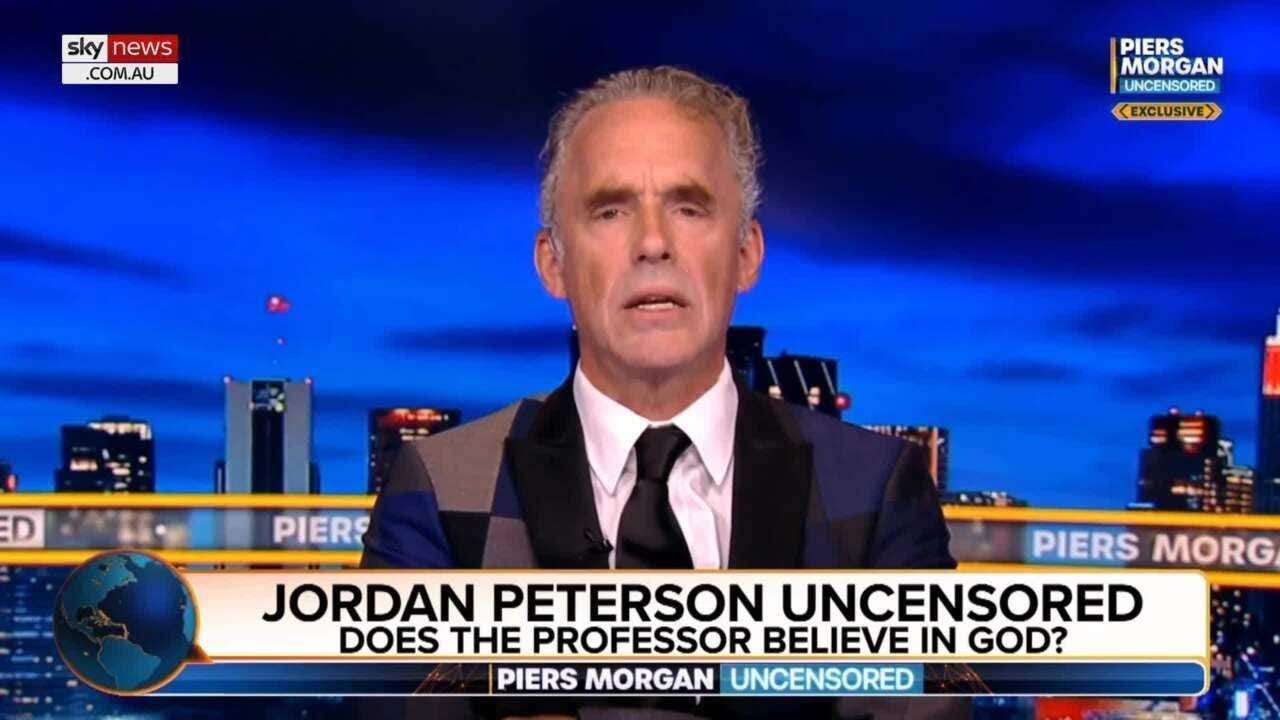
Peterson responds, as in, he says words following Piers’ question, yet these words hardly elucidate Peterson’s position.4 Some may think Peterson is undeniably a theist. Others may think he is agnostic or an atheist. Given these conflicting positions concerning Peterson’s theistic or atheistic status, is this an issue of the audience being incompetent and unable to interpret semi-complex language, or is Peterson unclear in his answers? To me, it is far more reasonable to conclude that Peterson is being unclear, at least to some degree.
Furthermore, this criticism, that I “lack understanding,” poorly demonstrates my supposed “wrongness.” I was not asking, “What is he saying?” But rather, “How does what he is saying succinctly address his interlocutor’s question/concern while adhering to his stated standards for discourse (clarity, precision, accuracy, etc.)?” The difference between these is quite subtle. It is not about what is being said, but why something is being said.
For rhetoric in public discourse to be clear and well-formulated, it must not be gibberish, but it also must be relevant to the subject at hand. Peterson, while not speaking in gibberish, often distracts from the subject at hand by discussing ideas which are irrelevant to the discourse. Peterson’s discussion with Greg in the above-mentioned Jubilee video is a great example of Peterson speaking intelligibly (i.e., not in gibberish), but discussing things that are disconnected from Greg’s explicit definition of God as a tri-omni being (i.e., not relevant to the discussion). I would highly recommend watching Rationality Rules’ video on this subject, as it demonstrates how Peterson uses word games in discourse.
I think that for many, it is not that they cannot understand Peterson, but rather that they struggle to understand how his positions relate to the topic of a particular discourse. My point is that Peterson could be clearer. The hypocrisy lies not in Peterson speaking intelligibly, but whether that intelligible speech is presented in a way that corresponds to the discussion. If a grammatically sensical essay has premises that do not relate to its thesis, those premises would, despite intelligibility, be deemed unclear, ill-formulated, and lacking in brevity, as they simply are not relevant to the broader argument/idea.
Frankly, I do not know what else I can say regarding this criticism, as it is difficult to demonstrate my understanding while also explaining why Peterson is unclear. It feels as though such a critique places me in a position where no matter what I say, it is invalid because “I just don’t get it.” Ultimately, my response could be stated as follows: a lack of clarity and brevity is often the fault of the communicator, not the interpreter.
“I used bad examples.”
Another prominent rebuttal concerned my examples: Peterson at the Oxford Union and Peterson on Piers Morgan Uncensored. Here, I will mainly focus on the former example, as I do not think the example of Peterson on Piers Morgan Uncensored is bad. As stated, Piers starts the interview by acknowledging how fans and viewers of Peterson debate whether he believes in God. I do not understand how these multiple competing interpretations are not indicative of his lack of clarity and brevity. If a strong argument is put forth demonstrating how I am wrong beyond simply claiming “it is wrong” or that “one party does not understand Peterson,” I will gladly respond to it.
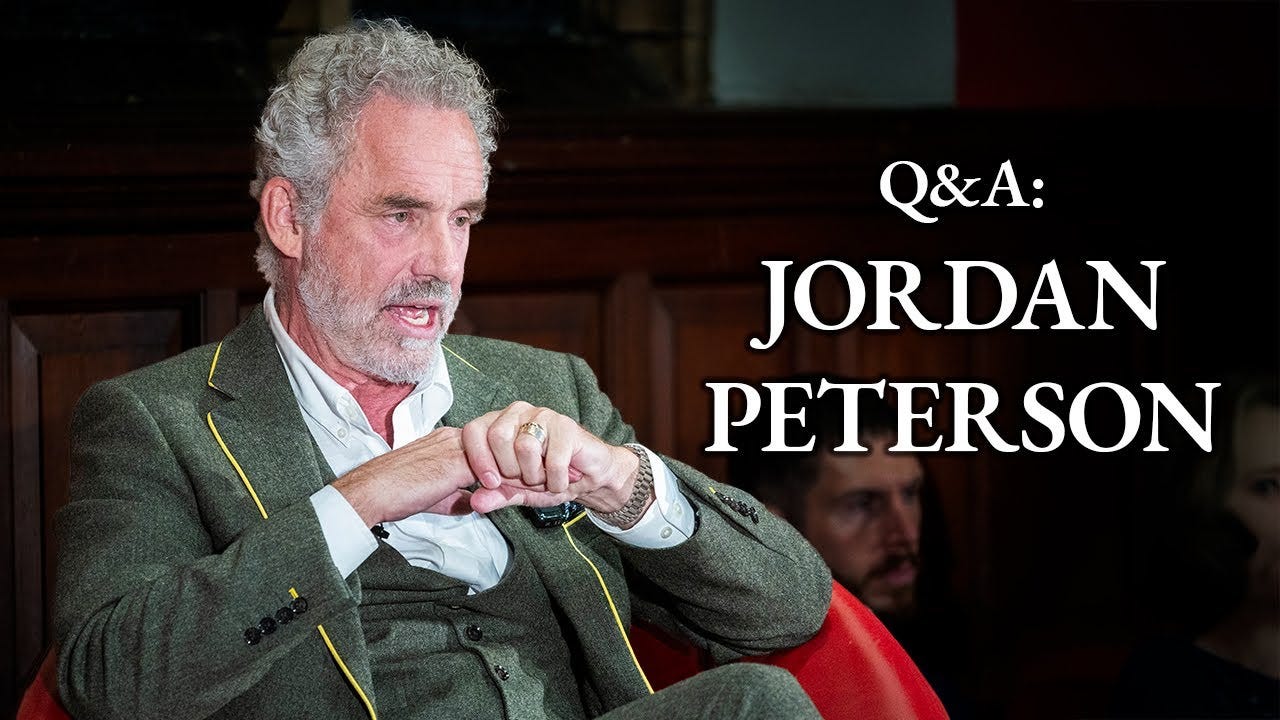
The example I want to focus on, as many commenters were appalled by my inclusion of it, is Peterson’s discussion with the student in the red scarf at the Oxford Union. Apparently, the student was acting in bad faith and misrepresented Peterson, and I should have called out such dishonesty. I have two main issues with this criticism: (1) It cannot be established beyond mere assumption that the student was acting in bad faith, and (2) it is more likely that the student slightly misinterpreted Peterson’s appearance on Joe Rogan rather than outright misrepresenting it.5
Given that these two issues are intertwined, I will primarily address why it is far more likely that the student misinterpreted Peterson and how that misinterpretation does not necessarily demonstrate malice or bad faith.
The student did not state the exact JRE episode she referenced, only that it occurred “a couple of years prior” to the Oxford Union Q&A. Despite this, it is clear that she is paraphrasing Peterson when he appeared on the JRE #1933,6 which was posted on YouTube on June 27, 2024. This led to initial confusion in my research for the video, as it was not “a couple of years prior.” However, on Spotify, the episode was published on January 28, 2023, which aligns with the student’s stated timeline.
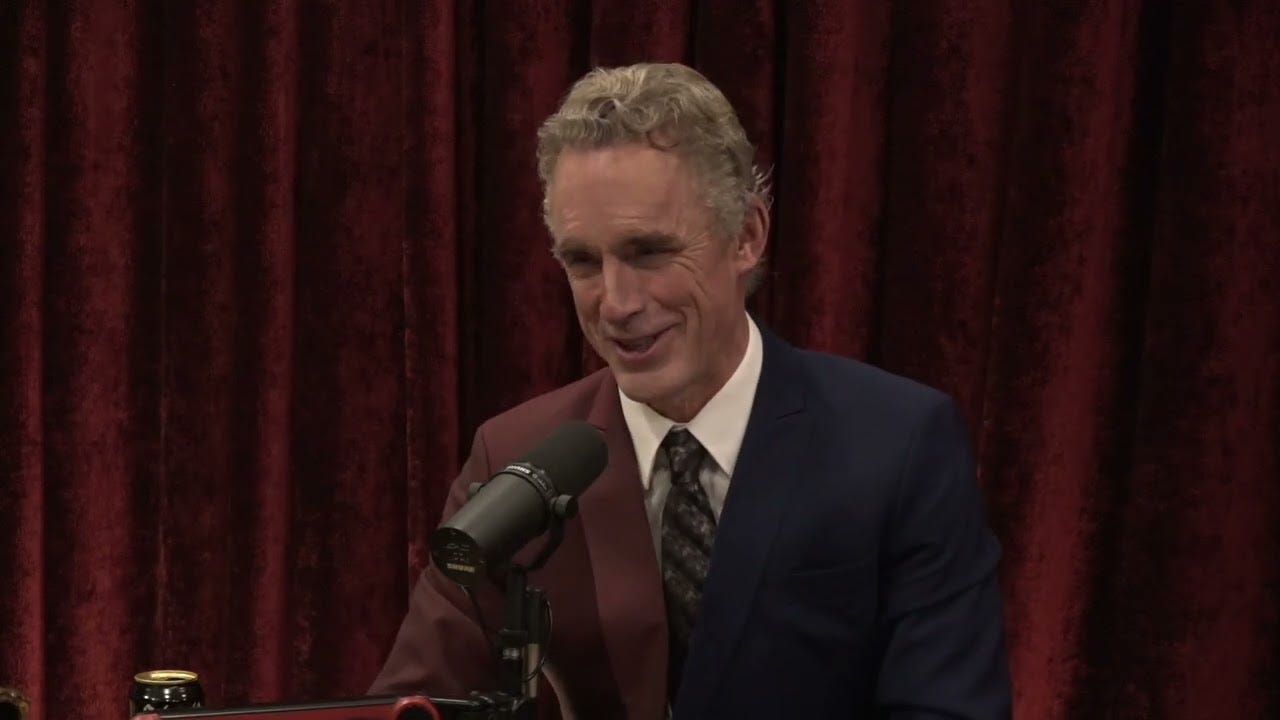
At around one hour into Rogan and Peterson’s conversation, they begin discussing transgender issues and psychological epidemics (psychological epidemics are similar in nature to social contagions). Peterson begins listing examples of what he has concluded are psychological epidemics, such as anorexia, bulimia, cutting, and the “satanic daycare ritual abuse accusations that came out in the 1980s.”7 In the same breath, Peterson effectively says the trans situation is another example of a psychological epidemic.
…the rule basically is that if you confuse people about a fundamental element of their identity, then those who are already so confused they're barely hanging on are going to fall prey to that and all hell's going to break loose. That's exactly what has happened in the transgender situation.8
Peterson is implying that the transgender situation is following the same “rule” as the other psychological epidemics he listed, and thus it can be considered a psychological epidemic, too. If you are skeptical of my representation of Peterson, please watch the original podcast. This line of discussion is the one referenced by the student at the Oxford Union. In what follows, I will demonstrate how the student did not intend to misrepresent Peterson, but rather possibly misinterpreted him.
The student begins by referencing the JRE episode and states that Peterson called being transgender a “sociological contagion.” Peterson nods his head in agreement to this initial statement. She goes on to say that Peterson compared transgender people to Satanists, to which Peterson replies, “No, I don’t think so.” The student further clarifies her statement, saying, “You called being transgender equivalent to participating in satanic rituals in the 1980s.”
Peterson claims the initial statement, that he compared transgender people to Satanists, is very different than the revised statement; Peterson states it is “seriously different” from the original proposition. I agree with Peterson that the statements are different, but not seriously different to the point of slander or malice. Thus, any misrepresentation is quite minor, and it is more accurately characterized as a reasonable, though not perfectly precise, interpretation rather than an outright misrepresentation.
Peterson made clear on the JRE that he believes the transgender situation follows the same rule as other psychological epidemics. From this, I’d argue it is fair to infer that Peterson is arguing that transgender people are participating in a psychological epidemic or social contagion. Peterson also makes clear that he believes those who participated in the satanic daycare rituals of the 1980s were also engaging in a psychological epidemic.
If partaking in satanic rituals makes one a satanist, then I’d argue it is fair to infer that satanists (at least a portion of them) are participating in a psychological epidemic, as the act of partaking in satanic rituals (like those in the 1980s), as Peterson would argue, is a psychological epidemic. Thus, when the student states that Peterson has called being transgender a social contagion and compared trans people to satanists, this paraphrased claim is not far off. Furthermore, I would like to add that when asking a question in a public forum, such as this (as I have done), it is common to try to distill a large question into a smaller inquiry in order to save time.
I am largely certain that the student was trying to do exactly that, and once pressed, she added further clarity. Rather than Peterson accepting that this was merely a miscommunication, he immediately assumed the student had bad intentions and used the “ill-formulated” question as a way to distract from the ethical undertones of the inquiry. To me, it was Peterson who acted in bad faith in this exchange. There is an additional quote from the student I want to address:
In the United States, trans youth have the highest rates of suicide among any demographic. How do you respond to those who believe your comments have cultivated a climate of hostility against trans people and contributed to this alarming rise in suicide rates?9
Peterson, instead of hearing this and interpreting it as: Anti-trans rhetoric from a large public figure can stimulate additional hate and hostility towards the trans community, and it is that hate and hostility which lessens social acceptance, hence contributing to higher suicides. Peterson seemed to interpret it as: My anti-trans claims cause suicide. These are not identical interpretations.
The student is highlighting that Peterson, as an individual with a large platform, is helping to create an environment where others agree with and spread anti-trans sentiment. That environment, which Peterson undeniably helps to foster, then may contribute to (not cause!) the higher rates of suicide among transgender individuals. Ultimately, what is questioned is why Peterson believes it is appropriate to spread such rhetoric, given that he has the power to influence the beliefs of others.
Some may think I am providing too extreme a steel man for the student’s position, but it seems to me that Peterson provided too extreme a straw man of it, and this interpretation is far more balanced and assumes the student is not acting in bad faith. Regardless of what was said, however, my inclusion of the Oxford Union example was used to illustrate how Peterson did not answer the substance of the question because it was “ill-formulated” (e.g., he demanded clarity). Returning to my thesis, Peterson demands clarity, but consistently lacks clarity, brevity, and, I might add, relevance in his statements and discourse; hence, the hypocrisy or double standard.
“I am wrong.”
This section is an “other rebuttals” section, as I received numerous rebuttals, but not all of them warrant lengthy responses. Some of the other rebuttals addressed trans issues and the importance of semantics. I will comment on these, but only briefly.
Firstly, Peterson is not an expert in transgender studies. While he is undoubtedly read on portions of the literature, he is not an objective arbiter of information, and much of what he espouses is contested science (like the social contagion theory). Peterson has social and political beliefs, and I am suspicious that these beliefs interfere with his opinions on the transgender situation.
Secondly, Peterson does spread anti-trans rhetoric. Some commenters were claiming that Peterson does not spread anti-trans rhetoric; instead, he is just making people uncomfortable in the pursuit of the truth. As mentioned, Peterson is not an expert in transgender studies, so his rhetoric, which largely leans one-sidedly against the efficacy of any gender affirming care or the legitimacy of the transgender identity, is anti-trans as it removes necessary nuance from these conversations that scholars must include in discussions to remain as unbiased as possible (basic standards for scientific inquiry).
Lastly, if countless individuals in the LGBTQ+ community view Peterson’s statements as anti-trans, they are likely anti-trans. I think that reducing the experiences of such individuals to “irrational emotions” is obtuse and dismissive. I am aware that many will find this point weak, but I, too, as an individual not in the LGBTQ+ community, view much of Peterson’s rhetoric as anti-trans, most notably when he refers to being transgender as a hypothetical identity (deligitimizing real experiences) and shares biased science on transgender issues.
On the importance of semantics: I am deeply concerned with the meaning of words when I write, and I acknowledge the importance of clarifying semantics. If Peterson had asked innocently, in discussions like the ones he had on Jubilee, “What conception of God are you discussing?” or made other subtle clarifications to further mutual understanding, I would have no problem with such requests. Yet, meanings and semantics are often clarified in many discourses that include Peterson; however, he still does not provide clear and concise answers (as seen in his discussion with Greg).
This is when I have a problem. Peterson’s interlocutors make their intentions clear, and still cannot obtain a legitimate, focused and relevant answer. This is where I question whether Peterson is using semantics to propel the dialogue forward or to abstract it, and this is not just because semi-deep subject matter is being discussed.
Concluding Thoughts
Upon retrospect, I still feel the essence of my argument holds. I believe my argument suffered most severely from including too little detail and would have benefited from more direct examples (both illustrative and literal). I still believe that Peterson applies unequal standards to his interlocutors in discourse; they can always be clearer, but he is always clear (despite how irrelevant what he is saying is), just esoteric, profound, and willing to grapple with metaphysical complexities (unlike those he converses with).
I am unsure if and when this will be seen and by whom, but again, to clarify, I am not trying to create a “hit piece” on Peterson; I am simply dissatisfied with his approach to discourse and believe it deserves criticism. Additionally, after Peterson’s appearance on Jubilee, many videos have been created that express similar concerns to mine. If you remain unconvinced, I recommend exploring some of those.
In conclusion, while Peterson regularly demands clarity from others and refuses to answer poorly formulated questions, he, too, often lacks clarity and brevity in his responses, frequently because his answers are completely irrelevant to the questions and concerns raised against him. While semantics are an important tool in seeking truth, Peterson's reluctance to accept common parlance and the established semantics of his interlocutors detracts from the help that semantic clarification could provide in that hunt for truth or mutual understanding. These conflicting standards reveal a double standard, and I argue that it is hypocritical for Peterson to ask for clarity and accuracy while failing to provide them himself.
I am not calling Jordan Peterson supporters members of a mob; I am just illustrating how it seemed my criticisms were futile, given the audience who viewed my video.
Obviously, internet opinion is not an infallible consensus. I am only explaining what the apparent majority who viewed the video seemed to think of it.
This quote is minimally paraphrased, though essentially the same as what Piers said.
In saying “…hardly elucidate Peterson’s position.” I am referring to the position which corresponds to the nature of the question being asked. When Piers asks, “Do you believe in God?” Common parlance informs us with great certainty that he is asking, “Do you accept it to be true that there exists an omniscient, omnibenevolent, omnipotent being colloquially known as God?” Peterson’s reply, while elucidating a position, does not elucidate the position which was intended to be known by Piers’ inquiry.
Some may view this as overly charitable, but I will show, with evidence, why it is only minimally charitable to the student. Additionally, this misinterpretation further indicates a lack of clarity on Peterson’s part.
Originally, due to the JRE being posted on different platforms (Apple Podcasts, Spotify, etc.), it was difficult to determine which episode was referenced as “a couple of years prior,” as the reference varies depending on the platform on which the episode was published. I am fairly certain I saw a different clip than the one the student actually referenced when creating my original video. Peterson has talked about social contagions and transgender related issues more than once on the JRE, so it was difficult to know whether what I initially viewed was correct (especially with publication dates being varied across platforms). Upon further investigation, however, I can confirm that JRE #1933 is the correct episode, and I should have been more thorough in my previous research.
Here, I am quite certain Peterson means that the Satanic rituals themselves were the psychological epidemic, not the accusations.
Peterson on JRE #1933 at approximately 1:15:50. The dialogue has been grammatically corrected for readability.
Student in the red scarf at the Oxford Union at approximately 26:05. The dialogue has been grammatically corrected for readability.